1916 Easter Rising
The 1916 Easter Rising
From the time the English became involved in Ireland, an enduring tradition in support of Irish independence endured.
 An Irish Parliament had been established in the 13th century, though it was far from an open and democratic institution. For instance, its membership was restricted to members of the Church of Ireland – the Anglican Church of England. The Penal Laws had furthered discrimination against not only Catholics, but all those who refused to acknowledge the English King as head of their Church, restricting their participation in any public employment including the military.
As a young barrister, elite attorney Wolfe Tone founded the United Irishmen Society in 1791 simultaneously in Belfast and Dublin. Tone and United Irishmen held as their goal abolishing any connection between Ireland & Britain. He was an Anglican Protestant but believed that Catholics & Ascendant Protestants should cooperate and not fight each other and argued for a joint political movement. Tone’s United Irishmen led an unsuccessful rebellion in 1798.
Following the failed rebellion, the Act of Union of 1800 was adopted, which abolished Ireland’s domestic Parliament and left Ireland ruled entirely by the English Parliament seated at Westminster.
Yet the tradition of Irish independence endured. The movement for Home Rule of Ireland gained strength in the late 19th century. In response, in Loyalist Ulster, the northern of Ireland’s four ancient provinces, Loyalists (or Unionists) established the Ulster Volunteer Force, a paramilitary organization. This, in turn, prompted the formation of the Irish Volunteers by Republican (or Nationalist) forces in the south. The Irish Volunteers were one of three groups behind the 1916 Easter Rising.
Probably the most important of the three was the secretive Irish Republican Brotherhood (IRB) which was formed in the mid-19th century. Thomas Clarke and Seán Mac Diarmada were the key figures in the IRB. Patrick Pearse was a member of both the Irish Volunteers and the Irish Republican Brotherhood and gave an oration at the graveside of O’Donovan Rossa, declaring “Ireland unfree shall never be at peace.” He became a key opinion leader in Irish republicanism. Scottish born Socialist James Connolly founded the Irish Citizen Army, the third of the key organizations. Over 200 women, most members of  Cumann na mBan, the League of Women, played a significant role in the Rising.
Easter Monday, 1916
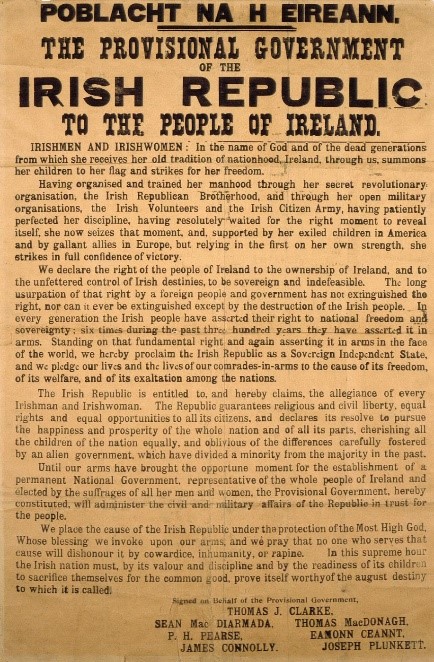
Shortly after noon on Easter Monday 1916, Pearse stood on the steps of the General Post Office (GPO) on O’Connell Street in Dublin and read the Proclamation of the Republic the leaders had drafted, signaling the beginning of the Easter Rising. Noteworthy for its time, it begins, “Irishmen and Irishwomen:”.
Rebels seized various key locations in Dublin. Connolly was Commandant of the Dublin Brigade. As the Dublin Brigade had the most substantial role in the rising, Connolly was de facto commander-in-chief. Connolly's leadership in the Easter rising was considered formidable. Michael Collins said of Connolly that he "would have followed him through hell." American-born Éamon de Valera led the brigade that occupied Boland's Mill.
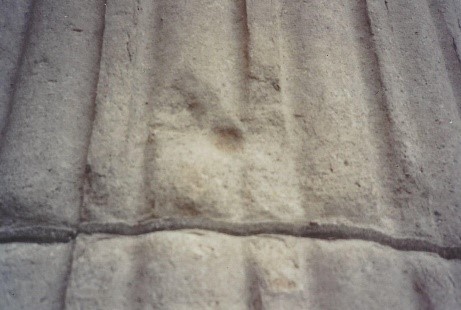
The six-day conflict was largely confined to Dublin. When the Rising began, British authorities had just 400 troops to confront roughly 1,000 rebels. By Friday, about 18-20,000 soldiers had been amassed in the capital against maybe 1,600 rebels while much of the city center had been destroyed by British artillery fire. Bullet marks can be seen to this day in the columns outside the GPO and in several statues along O’Connell street.
On Saturday, Pearse surrendered unconditionally on behalf of the Volunteers and issued orders to this effect. A total of 450 people were killed during the rebellion, among them 64 rebels and numerous civilians. 2,614 people were injured, and nine others were reported missing, almost all in Dublin.
The leaders of the rebellion were arrested and paraded through the city to Kilmainham Gaol. Far from being seen as heroes, crowds jeered and spat at them along the way. The Rising had not caught popular opinion the way the organizers had anticipated. The British court marshaled the rebel leaders and sentenced them to death. Fourteen, including all the signatories of the Proclamation, were executed by firing squad at Kilmainham Gaol between May 3-12. (Interesting to note, de Valera was spared execution in part because of his US citizenship.) They wrote moving and articulate journals and last letters from the prison. It was the stream of these executions that dragged on for days that weighed on public opinion. In fact, Connelly had been wounded in the Rising and was so ill and just days from death that he could not stand for the firing squad, so he was tied to a chair to be executed. The executions, and Connolly’s particular circumstances, started to shift public opinion about the Rising itself and lead to immediate political wins and subsequent independence of the Free State and Republic.
Irish today celebrate the rebels leaders as martyrs and freedom fighters and credit them with bringing about Irish independence. The Rising is immortalized in many ways, not the least of which is in WB Yeats, work, “A Terrible Beauty.”